
Sky Organization
Since, rainbows appear in the sky, the understanding of the Hawaiian way in which the sky was organized in ancient times is needed. Therefore, the goals of this section are to describe the names of the vertical strata and the positions of the sun.
This section has three important sources of knowledge. The first, the famous book by David Malo called Hawaiian Antiquities. Malo was one of the famous Hawaiian scholars of the 19th century. Published in 1838, his book is a valuable reference that preserves traditional Hawaiian knowledge. Within his book, Malo explains the vertical strata (called pōʻai lewa) and the positions of he sun travels in as it travels across the sky (called pōʻai Kahiki). The second important knowledg source are the Hawaiian language news paper articles published by Samuel Kamakau in 1869. Kamakau was also one of the famous Hawaiian scholars. He also wrote about the vertical strata and the posiitions of the sun. The third source is the Edith Kanakaʻole Foundation. It is a research organization of the present time, they have published some valuable information about the organization of the natural world by Hawaiians in the ancient times. These 3 knowledge sources were used as the foundation of this section.
Traditional Hawaiian knowledge about the natural world was organized within 3 houses of knowledge. Namely, Papahulilani, Papahulihonua, and Papanuinānaumoku. [1] The sky belongs to Papahulilani, and in the past the sky was closely observed by priests and commoners alike. Furthermore, according to Malo and Kamakau, the sky was organized into strata as a way to understand the types of things that often were appearing above the earth, such as clouds, rains, rainbows, etc.[2] According to Malo, the suns travels across tha sky was also organized into positions, namely the pōʻai Kahiki.[3]
Rainbows appear within some vertical strata. Furthermore, the majority of time, their appearance depends on the type of rainbow and the position of the sun. The altitude of the vertical strata was estimated in this section as a way to understand the vertical strata that the types of rainbows appear within.
[1] Edith Kanakaʻole Foundation. 2017. Papakū Makawalu. http://edithkanakaolefoundation.org/papakuMakawalu.php.
[2] David Malo. 2020. The Moʻolelo Hawaiʻi of David Malo, Ka ʻŌlelo Kumu. Edited by Jeffrey Lyon. Vol. 1. Honolulu, HI: University of Hawaiʻi Press and Bishop Museum Press., ʻaoʻao 139.
Samuel Kamakau. 1870. "Ka Moolelo Hawaii." Ke Au Okoa, Maraki 31: 1.
[3] David Malo. 2020. The Moʻolelo Hawaiʻi of David Malo, Hawaiian Text and Translation. Edited by Charles Langlas and Jeffrey Lyon. Vol. 2. Honolulu, HI: University of Hawaiʻi Press and Bishop Museum Press. ʻaoʻao 80.
The Three Hawaiian Knowledge Houses
The first thing that is needed in understanding the vertical strata and sun positions is the system of knowledge in which Hawaiians organized the natural world. As mentioned above, there are 3 houses of knowledge and they are mentioned within Epoch 12 of the Kumulipo.[1] They are explained below.[2]
-
Papahulihonua: The earth (land and ocean) are located within this knowledge house. Namely the evolution and the processes of the earth and the ocean. It is also some experts who know the relationships between the earth, the sky, and living things.[3]
-
Papahulilani: The sky from the surface of the earth all the way to the stars. Within Papahulilani ia the sun, wind, stars, rain, rainbows, etc. It is also some experts who know the relationships between the earth, the sky, and living things.
-
Papanuihānaumoku: From the embryo until death all plants and animals reside within Papanuihānaumoki. It is also some experts who know the relationships between the earth, the sky, and living things.
These three houses of knowledge, the Hawaiian knowledge systemare the foundation for understanding the Hawaiian perspective of the natural world.[4]
[1] Queen Liliʻuokalani, (2016). The Kumulipo An Hawaiian Creation Myth (Third Printing). Honolulu, HI: Pueo Press, Wā 13 ʻaoʻao. 66-67.
Kawena Johnson (2000). The Kumulipo Mind . Honoluu, HI: Wā 13 ʻaoʻao 135.
[2] Edith Kanakaole foundation: http://edithkanakaolefoundation.org/papakuMakawalu.php.
[3] Wahi a Kamakau, “O ke kuhikuhi puuone – He Papahulihonua kekahi inoa. He oihana akamai loa keia i ka wa kahiko, a he poe akamai loa no hoi lakou i na mea huna ma ka aina” S.M Kamakau. 1867. "Ka Moolelo o na Kamehameha." Ka Nupepa Kuokoa. Vol. VI. Honolulu, HI, Dekemba 28. 1.
[4] Edith Kanakaole foundation: http://edithkanakaolefoundation.org/papakuMakawalu.php.
Papahulilani:
Papahulilani is where rainbows appear. Perhaps, the size of Papahulilani is larger than the other houses of knowledge. It extends to the highest heavens. The primary gods of Papahulilani and Kāne (Kāne-nui-ākea) and Kanaloa. Kū and Lono are the secondary gods.[1] All the sky phenomena are provided by the aforementioned gods. Therefore, these phenomena are under supernatural control.
[1] Kalei Nuʻuhiwa and Pualani Lincoln-Maielua. 2022. "Papahulilani." Papakū Makawalu Workshop. Hilo, HI: Edith Kanakaʻole Foundation, January 15.
The Strata of the Sky
According to Malo, there are four strata of the sky between the edge of the atmosphere and the ground.[1] These strata are explained below and also shown in figure below.[2]
-
Ka Paʻa i luna: This strata extends from the top of the atmosphere all the way to where the stars reside.
-
Ka Lewa lani: The highest strata of the sky is the lewa lani. It extends from the tops of the high clouds all the way to the edge of the atmosphere.[3]
-
Ka Lewa nuʻu: This is the strata where the clouds wander all the way until where large birds fly. Namely the mōlī, the kaʻupu, the ʻā, the ʻiwa, etc.[4]
-
Ka Lewa lani lewa: From the tops of the tall trees until the base of the clouds is the Lewa lani lewa. The light clouds and mist reside in this strata and it is where small birds fly, such as the ʻāpapane, the ʻiʻiwi, the ʻamakihi, the ʻio, the piha ʻekelo, etc.[5] Malo shows the Lewa lani lewa, however, interestingly, according to the editor of Maloʻs book (republished in 2020) the lewa lani lewa is a strange name and possibly incorrect.[6]
-
Ka Lewa hoʻomakua: This strata ascends from the base of short trees (or the head of a person) until the tops of trees. According to Malo, if a person is hanging within a tree and his feet dangle below, that is the strata of lewa hoʻomakua.[7]
-
Ka Paʻa i lalo: This is the surface of the earth.
[1] David Malo. 2020. The Moʻolelo Hawaiʻi of David Malo, Ka ʻŌlelo Kumu. Edited by Jeffrey Lyon. Vol. 1. Honolulu, HI: University of Hawaiʻi Press and Bishop Museum Press. ʻaoʻao 139.
[2] ʻAʻole kēia kaha kiʻi he kiʻi pālākiō.
[3] David Malo. 2020. The Moʻolelo Hawaiʻi of David Malo, Ka ʻŌlelo Kumu. Edited by Jeffrey Lyon. Vol. 1. Honolulu, HI: University of Hawaiʻi Press and Bishop Museum Press. ʻAoʻao 139. Kalei Nuʻuhiwa. 2019. "Class notes and handouts." HWST 271: Papahulilani Hawn Astronomy I. Honolulu, HI.
[4] Kalei Nuʻuhiwa. 2019. "Class notes and handouts." HWST 271: Papahulilani Hawn Astronomy I. Honolulu, HI. ʻAʻole i hoʻopuka ʻo Malo i nā lāhui manu kikoʻī o kēia pōʻai.
[5] Kalei Nuʻuhiwa. 2019. "Class notes and handouts." HWST 271: Papahulilani Hawn Astronomy I. Honolulu, HI. ʻAʻole i hoʻopuka ʻo Malo i nā lāhui manu kikoʻī o kēia pōʻai.
[6] David Malo. 2020. The Moʻolelo Hawaiʻi of David Malo, Hawaiian Text and Translation. Edited by Charles Langlas and Jeffrey Lyon. Vol. 2. Honolulu, HI: University of Hawaiʻi Press and Bishop Museum Press. ʻaoʻao 81 (kuhia o lalo #6)
[7] k.l.
Sky organization according to Malo

Some Different Strata
Malo and Kamakau differ in their knowledge of the sky organization.[1] As for the data that was collected from Kamakauʻs writings, there are 6 strata between the ground and the edge of the atmosphere. These are explained below and shown in the figure below as well.[2]
-
Ka Paʻa i luna: This strata extends from the top of the atmosphere all the way to where the stars reside.
-
Ka Lewa lani: The highest strata of the sky is the lewa lani. It extends from the tops of the high clouds all the way to the edge of the atmosphere. There are many gods associated with the lewa lani such as: Kanehekili, Kanewawahilani, Kahoalii, and Kauilanuimakehaikalani.[3]
-
ʻO Kamakuʻialewa: This is located equal distance from the top of the atmosphere down and the earth upward. It is also called kamakakuʻialewa or kamakuʻikahialewa.
-
ʻO Keapoalewa: Below kamakuʻialewa is the strata called keapoalewa.
-
Ka Lewa nuʻu: Below keapoalewa is the lewa nuʻu. It is the place where birds fly. The gods of the lewa nuʻu are called the gods of heaven.[4]
-
Ka Hakaalewa: Inā, hoʻolewa iho kekahi kanaka i kona wāwae i ka manawa āna e paʻa ana i kekahi lālā kumulāʻau, aia kona wāwae ma loko o ka pōʻai hakaalewa.
-
Ka Lewa hoʻomakua: Inā, e kū ana kahi kanaka ma ka honua, a pupuʻu aʻe kekahi wāwae i luna, a koe kona wāwae ʻē aʻe pili ua ka honua, ʻo lewa hoʻomakua ka inoa o ia pōʻai. ʻO ia hoʻi, mai ka paʻa i lalo a i kahi o ia wāwae i luna.
-
Ka Paʻa i lalo: ʻO ia kahi pili paʻa i ka honua.
It is perhaps difficult to compare Maloʻs organizational system with Kamakauʻs, because, Kamakau did not define the strata below the lewa nuʻu and above the hakaalewa. Seems as if this would be the strata that was called the lewa lani by Malo, however, that is not properly understood. The two systems are different. Which system is the correct one? If you have different versions of the traditional Hawaiian stories, each of them is correct. Namely, these stories are told by different people with different thoughts. Perhaps, like these traditional stories, the systems of both Malo and Kamakau are correct. Dear reader, the author is not choosing a correct system. Therefore, these two systems are used.
[1] Samuel Kamakau. 1869. "Ka Moolelo Hawaii." Ke Au Okoa, Nowemapa 4.
[2] From Ancestral Places: Understanding Kanaka Geographies, by Katrina-Ann R. Kapāʻanaokalāokeola Nākoa Oliveira, copyright © 2014. Used with permission of Oregon State University Press. ʻaoʻao 48-50. ʻAʻole kēia kaha kiʻi he kiʻi pālākiō.
[3] Samuel Kamakau. 1870. "Ka Moolelo Hawaii." Ke Au Okoa, Maraki 31: 1.
[4] k.l.
Sky organization according to Kamakau

An interesting question perhaps, what is the altitude of the vertical strata? They were not measured by Malo or Kamakau using the western system of the foreigners. An important question, since the western perspective/worldview is different than the Hawaiian perspective/world view, is it perhaps proper to show the western knowledge within the perspective of the Hawaiian? In the view of the westerner, science is the only thing that shows the truth. In the view of the Hawaiian, there are many truths. One goal of this project is the blending of some data of the westerner with the view of the Hawaiian concerning the rainbow types and their appearance. Therefore, in this section, the altitude of the strata were chosen through some different types of the analysis. This analysis starts with the lowest strata, Lewa hoʻomakua, shown below:
1. Ka lewa hoʻomakua: The definitions of Malo and Kamakau are different in relation to the height of this strata. As was defined above, according to Kamakau, a person standing on the ground, a lifts one foot up high, his foot defines the height of the strata.[1] This heights, is perhaps approximately two feet. According to Malo, if a person is in a tree and dangles his feet down, that is the height of the lewa hoʻomakua.[2] Which tree was Malo referring to? Here is an estimate: The height of the Koa tree is larger than other trees in Hawaiʻi, and it grows up to 115 feet.[3] From which branch are the feet dangling from? If a person is 6 feet tall, from a lower branch (perhaps 10 feet in height) his would dangle to about 4 feet. Inā, paʻa kekahi kanaka (ma kahi o 6 kapuaʻi kona kiʻekiʻe) i kekahi lālā haʻahaʻa (ma kahi paha o 10 kapuaʻi ke kiʻekiʻe), e lewa ana kona wāwae ma kahi o 4 kapuaʻi. Another source [4] indicates that the strata of lewa hoʻomakua is from the base of a short tree (or the head of a person) until the top of a tall tree (a Koa tree perhaps), in other words, approximately 115 feet. It seems as if, this strata does not extend all the way up to 115 feet, as a result of the other definitions. Therefore, for this project, the estimate of the height the lewa hoʻomakua is perhaps three feet.
2. Ka hakaalewa: In the data collected from Kamakauʻs writing, If a person is hanging his feet down when he is in a tree branch, then his feet are in the hakaalewa. Therefore, perhaps 4 feet is the height of this strata.
3. Ka lewa lani lewa: Kamakau did not speak about the lewa lani lewa. Only Malo describes this strata. It is located below the lewa nuʻu. However, it is described by another source[5] From the top of the tall trees until the base of the clouds, the lewa lani lewa is located. The fog and mist are found in this strata, and it is the strata where small birds fly. This altitude can be used to estimate the height of the lewa lani lewa. The myhah bird flys as high as 9,800 feet above sea level.[6] The ʻiʻiwi (scarlet honey creeper) flys to 4,100 feet,[7] and the ʻamakihi, 9,500 feet.[8] The angle of 20 degrees can also be used (see diagram at below left) as a way to clarify the height of this strata. At the angle of 20 degrees above the horizon, it is approximately 6,000 feet. The average height of these data is 7,300 feet. Therefore, the boundries of the lewa lani lewa are perhaps 3 and 7,300 feet.
4. Ka lewa nuʻu: This is the strata that large birds fly.[9] For example, the laysan albatross, the black-footed albatross, the booby, the frigate bird, the plover etc. The frigate bird often flys up to 13,000 feet.[10] The plover, it can fly up to 16,000 feet.[11] The average of the flight altitudes of these birds is 14,500 feet. Therefore, the altitude of the lewa nuʻu is perhaps between 7,300 and 14,500 feet above sea level.
5. The keapoalewa: This strata is located between the lewa nuʻu and the kamakuʻialewa. Therefore, it is between 14,500 and 30,000, see the analysis for the kamakuʻialewa below.
6. The kamakuʻialewa: This strata is located equal distance from the top of the atmosphere down and the ground up. If the top of the lewa lani is located at 60,000 feet (see the definition of the lewa lani below), the 30,000 feet perhaps is the altitude of this strata. Since, the kamakuʻialewa is directly below the lewa lani, between 30,000 and 60,000 feet is the altitude of the kamakuʻialewa.
7. Ka lewa lani: The highest strata is the lewa lani. It is located from the top of the tallest clouds all the way to the top of the sky.[12] What is this altitude? Perhaps 60,000 feet is the height of the tallest clouds.[13] It is thought perhaps that this is the top of the sky, however, according to some reports, 100 km (328,00 feet) is the top of the sky that is called the Karmin line.[14] For this project, 60,000 feet is used as the base of the lewa lani.
The results of this analysis are shown in the table below (in the left column). What is the value of these results? They can perhaps be used for comparing the Hawaiian perspective with the western scientific perspective for the purpose of recognizing the position of the various rainbow types in the sky. This is a mixture of the two perspectives, and perhaps it can be used as a way to interpret the type of rainbow that we are seeing
Estimated altitudes of the sky strata
[1] Samuel Kamakau. 1869. "Ka Moolelo Hawaii." Ke Au Okoa, Novemaba 4: 1
[2] David Malo. 2020. The Moʻolelo Hawaiʻi of David Malo, Ka ʻŌlelo Kumu. Edited by Jeffrey Lyon. Vol. 1. Honolulu, HI: University of Hawaiʻi Press and Bishop Museum Press. ʻaoʻao 139.
[3] n.d. DLNR. Hawaii.gov. State of Hawaiʻi. Accessed November 2022. https://dlnr.hawaii.gov/forestry/info/big-tree/koa/#:~:text=Koa%20is%20the%20largest%20native,heights%20of%20approximately%20115%20fet.
[4] Kalei Nuʻuhiwa. 2019. "Class notes and handouts." HWST 271: Papahulilani Hawn Astronomy I. Honolulu, HI.
[5] Kalei Nuʻuhiwa. 2019. "Class notes and handouts." HWST 271: Papahulilani Hawn Astronomy I. Honolulu, HI.
[6] Moumita Dutta. 2022. Myna Bird Facts. 10 20. Accessed November 26, 2022. https://kidadl.com/facts/animals/myna-bird-facts.
[7] n.d. DLNR. Native Birds of Hawaiʻi: ʻIʻiwi. State of Hawaiʻi. Accessed November 26, 2022.https://dlnr.hawaii.gov/wildlife/birds/iiwi/.
[8] n.d. DLNR. Native Birds of Hawaiʻi: ʻamakihi. State of Hawaiʻi. Accessed November 26, 2022. https://dlnr.hawaii.gov/wildlife/birds/hawaii-amakihi/.
[9] Kalei Nuʻuhiwa. 2019. "Class notes and handouts." HWST 271: Papahulilani Hawn Astronomy I. Honolulu, HI.
[10] H. Weimerskirch, et al. 2016. Frigate birds: In the air for months at a time. Accessed November 2022. https://www.sciencedaily.com/releases/2016/07/160701120733.htm#:~:text=In%20order%20to%20glide%20over,take%20advantage%20of%20strong%20updrafts.
[11] Oscar W. Johnson, and Susan Scott. 2016. Hawai'i's Kōlea: The Amazing Transpacific Life of the Pacific Golden-Plover. Honolulu, HI: University of Hawai'i Press.
[12] Kalei Nuʻuhiwa. 2019. "Class notes and handouts." HWST 271: Papahulilani Hawn Astronomy I. Honolulu, HI.
[13] NOAA. n.d. The Four Core Types of Clouds . National Weather Service. Accessed November 2022. https://www.weather.gov/jetstream/corefour.
[14] Nadia Drake. n.d. Where, exactly, is the edge of space? It depends on who you ask. Accessed November 2022. https://www.nationalgeographic.com/science/article/where-is-the-edge-of-space-and-what-is-the-karman-line.

The Positions of the Sun
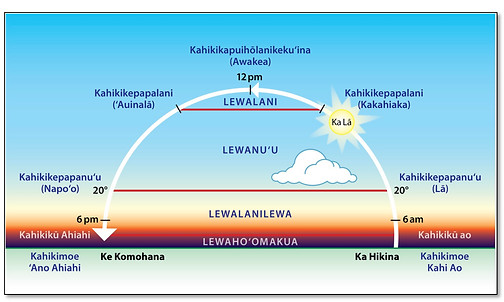
When the sun is travelling along itʻs path in the heavens, there are some names concerning itʻs position, called pōʻai Kahiki. There are 7 positions of the sunʻs path, and the first part of each name is Kahiki. Kahiki is the day time path position of the sun. These positions were explained by Malo, a they are also explained below and shown in the diagram that follows.
-
ʻO Kahikimoe Kahi (Ao): This is the position of the sun below the horizon in the east.
-
ʻO Kahikikū (Ao): This is the position of the sun directly above the horizon in the east.
-
ʻO Kahikikepapanuʻu (Lā): This is the position of the sun at the time the sun is at twenty degrees above the horizon in the east. It is the position of the sun that has the name lā or day. When the sun is moving from the position of Kahikikū ao to the position of Kahikikepapanuʻu (Lā), that movement is called Keʻe.[2]
-
ʻO Kahikikepapalani (Kakahiaka): When the sun as at this position in the sky in the morning, it is called Kahikikepapalani. This is morning time,
-
ʻO Kahikikapuihōlanikekuʻina: The sun is directly overhead at this time, and has this name Kahiki-kapu-i-Hōlani-ke-kuʻina. Hōlani is a sacred place. A supernatural place in ancient tradition.[3] This is noon time.
-
ʻO Kahikikepapalani (ʻAuinalā): When the sun is at this position in the afternoon it is called Kahikikepapalani.
-
ʻO Kahikikepapanuʻu (Napoʻo): When the sun is at an angle of twenty degrees above the horizon in the afternoon, this position is called Kahikikepapanuʻu. It is the beginning time of sunset. When the sun is moving from Kahikikepapanuʻu to Kahikikū ahiahi, itʻs movement is called Keʻe.
-
ʻO Kahikikū ahiahi: The sun is above the horizon in the west.
-
ʻO Kahikimoe ʻAno Ahiahi: The sun as below the horizon in the west.
The positions of the sun
When the sun is travelling between Kahikikepapanuʻu (Lā a i ʻole Napoʻo) and Kahikikū (Ao a i ʻole Ahiahi), these are the times dawn and dusk. The word alaula, it can be thought of as ala ʻula or aka ʻula. These are the times when rainbows with much red color frequently appear.
The aforementioned sun positions (Kahiki) cannot be used for the various other things that are moving in the heavens, such as the stars the moon, comets, etc. This is because there are different names for the positions of the bodies that move in the night.[4]
The relationship between the sky strata (pōʻai lewa) and the sun positions (pōʻai Kahiki):
Since the sky strata and the positions of the sun are different, an interesting question perhaps that comes to mind, what is the relationship of the sky strata and the sun positions? And how do we understand their altitudes in relation to each other. There is a method that is known for understanding this relationship which is shown in the figures below.[5]
It is perhaps possible to consider an English metaphor for the relationship of the sky strata and the sun positions, namely a snow globe. The sun moves along the glass of the globe, and rainbows appear within the inside liquid of the globe.
Some closing thoughts
The ancestors were indeed clever, and interesting indeed their organization of the sky and the sun positions. Understanding these strata and positions is important at the time a rainbow appears in the sky, because it is an important thing for interpreting the type of rainbow and itʻs signs and omens.
[1] David Malo. 2020. The Moʻolelo Hawaiʻi of David Malo, Hawaiian Text and Translation. Edited by Charles Langlas and Jeffrey Lyon. Vol. 2. Honolulu, HI: University of Hawaiʻi Press and Bishop Museum Press. ʻAoʻao 80.
Hōʻike wale nō ʻo Malo i kēia mau Kahiki he ʻelima, eia naʻe, ʻo ka ʻehā i koe, like a like nā inoa ma hope o ka neʻe ʻana o ka lā ma hope o ke awakea. E hahai ʻia ana ka pela ʻia o nā Kahiki e hōʻike ʻia ma loko o ke paʻi hou ʻia (2020) o kā Malo, ʻo ia hoʻi ka mea nona nā kahakō a me nā ʻokina. Aia kekahi mau pela ʻokoʻa ʻana ma loko kā Kamakau, ʻo ia hoʻi, ʻo Kahikikeʻapapanuʻu, ʻo Kahikikeʻapapalani.
[2] k.l
[3] k.l
[4] k.l
[5 Kalei Nuʻuhiwa. 2019. "Class notes and handouts." HWST 271: Papahulilani Hawn Astronomy I. Honolulu, HI.


Na Julianufer | Dreamstime.com ke kiʻi